A mortgage note can look attractive when you focus on the monthly payment or the discount from the unpaid balance. The real decision is more complicated. Purchase price, collateral, servicing costs, remaining term, payment history and default risk all affect the outcome.
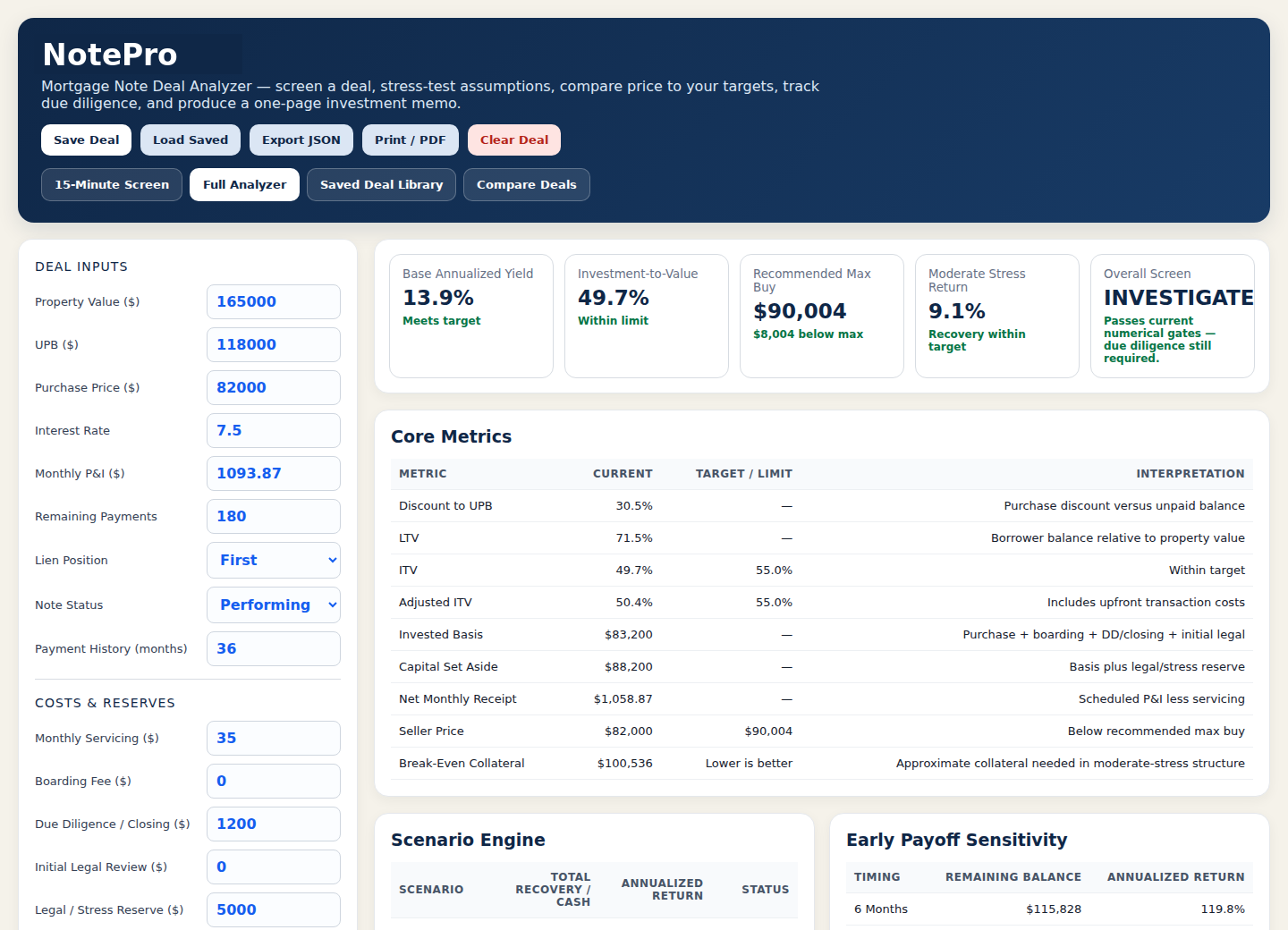
NotePro is designed to put those moving parts into one organized review. It runs in a web browser, accepts the deal information you enter and turns it into a set of screening metrics, price targets and stress scenarios.
Key takeaways
- NotePro analyzes information you enter; it does not search for notes or verify a seller’s claims.
- It combines return calculations with collateral, cost, risk and due-diligence questions.
- Its strongest value is helping you compare the asking price with your own assumptions and limits.
- A positive screen means “investigate further,” not “buy this deal.”
What exactly is NotePro?
NotePro is the full deal-analysis tool included with the Note Investor Blueprint. It is delivered as a browser-based file, so you can open it in Chrome, Edge, Safari or another modern browser. There is also an Excel analyzer in the bundle for buyers who prefer a spreadsheet.
The browser version includes four working areas: a quick 15-minute screen, the full analyzer, a saved-deal library and a side-by-side comparison view. Deals saved in the browser stay on that device unless you export a backup.
The illustrative sample deal
The walkthrough uses a fictional performing first-lien note. These figures are examples only and are not presented as a real opportunity.
Step 1: Enter the deal facts and costs
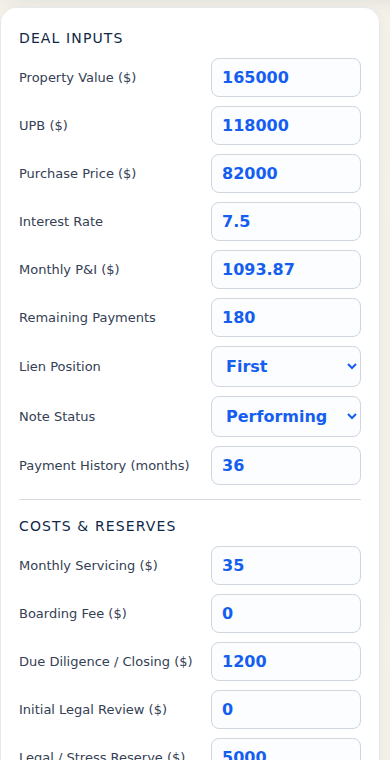
The analyzer starts with the figures that define the note and the cost of acquiring it. That includes the estimated property value, unpaid balance, purchase price, interest rate, monthly payment, remaining term, lien position and whether the note is currently performing.
It also asks for expenses that basic yield calculators often ignore, such as servicing, boarding, due diligence, closing, initial legal review and a stress reserve.
This distinction matters because an $82,000 purchase price is not necessarily an $82,000 investment. In this example, the invested basis becomes $83,200 after initial costs, while the planned capital set aside reaches $88,200 after the reserve.
Step 2: Read the result as a screen—not a verdict
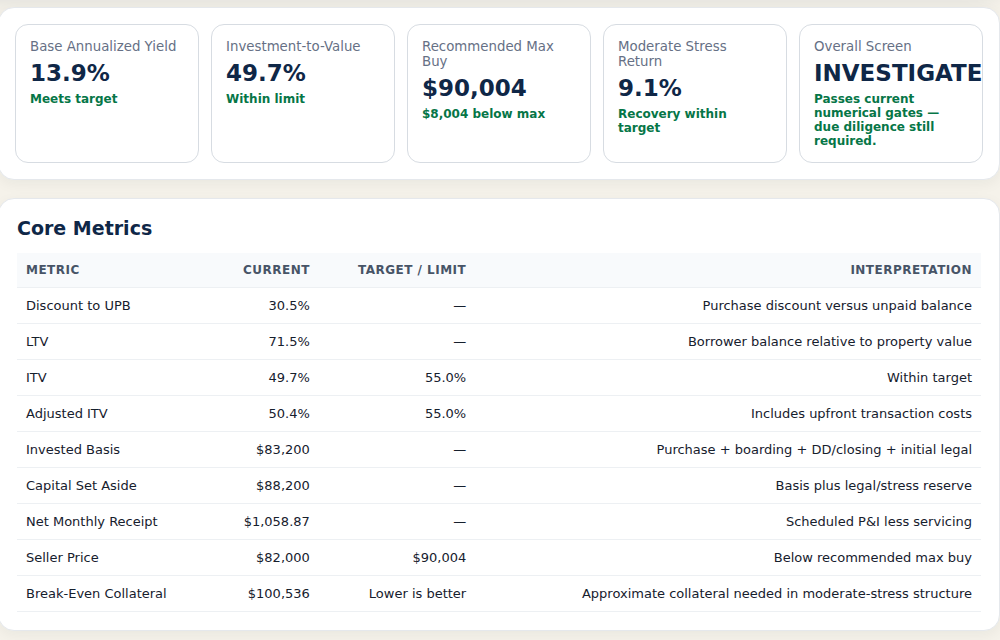
For the sample assumptions, NotePro displays a 13.9% base annualized yield, a 49.7% investment-to-value ratio and a recommended maximum purchase price of $90,004. The seller’s $82,000 price is below that model-based ceiling.
However, the overall screen says Investigate. That wording is intentional. The current numbers pass the selected numerical gates, but the documents, collateral, payment history and legal position still need verification.
Why the core metrics matter
- Discount to UPB: compares the purchase price with the unpaid principal balance.
- Loan-to-value: compares the borrower’s balance with the estimated property value.
- Investment-to-value: compares the investor’s cost with the property value.
- Net monthly receipt: subtracts the servicing assumption from the scheduled payment.
- Break-even collateral: estimates the property value needed to support the modeled stress structure.
Step 3: Test more than the best-case path
The Scenario Engine is meant to challenge the base case. A note may continue paying, pay off early, suffer an interruption or require a longer and more expensive recovery process. Each path changes timing, cash flow and annualized return.
The early-payoff view is especially important when buying at a discount. Receiving the balance early may increase the annualized return, but it also ends the future monthly income stream. The result depends on price, balance, timing and the investor’s original goal.
The moderate-stress return in the sample is 9.1%. That figure is not a forecast. It is the output of a defined set of stress assumptions and should be read alongside the assumptions that produced it. See why cash yield is only a starting point
Step 4: Keep due diligence connected to the calculation
A calculator is most dangerous when a precise-looking percentage creates false confidence. NotePro includes a risk scorecard, due-diligence checklist and deal memo so unresolved questions stay attached to the numbers.
Typical items include ownership and assignment documents, lien priority, payment history, servicing records, taxes, insurance, occupancy, property condition, valuation support and state-specific legal considerations.
Step 5: Save and compare deals
The saved-deal library keeps multiple opportunities from turning into a pile of disconnected notes and spreadsheets. A saved record can be reopened, reviewed and compared with another deal. The export function creates a backup that can be stored separately.
Comparison is useful because the highest headline return may not offer the strongest overall structure. One deal may have better collateral, a longer payment history, lower servicing friction or more room below the user’s maximum price.
Free Analyzer versus NotePro
What comes with the complete Blueprint?
NotePro is one part of the Note Investor Blueprint system. The bundle also includes the 86-page illustrated guide, Investor Workbook, Excel analyzer and Quick Start Guide. The guide explains the concepts; the workbook organizes the investigation; the tools help test the assumptions.
Learn the process and use the tools together.
Get the Note Investor Blueprint, Investor Workbook, NotePro browser analyzer, Excel analyzer and Quick Start Guide.
Educational materials and calculators only. No investment recommendations or promised returns.