Cash yield is popular because it is fast. Multiply the monthly payment by twelve, divide by the purchase price and you have a percentage that seems easy to compare.
The problem is not the math. The problem is treating that one percentage as the complete return.
Key takeaways
- A scheduled mortgage payment normally contains both principal and interest.
- Gross cash yield ignores many costs and says nothing about when money arrives.
- Early payoff can improve one deal and weaken another, depending on price and timing.
- Missed payments can reduce cash flow while expenses continue.
- Collateral and documentation matter because yield alone does not measure recoverability.
What cash yield actually measures
A basic cash-yield calculation compares a year of expected cash receipts with the cash invested. For example:
That is a useful screening number. It tells you how large the scheduled payment stream is relative to the price. It does not prove that twelve payments will arrive, that the price includes every acquisition cost or that the entire payment is profit.
A payment is not all interest
On an amortizing mortgage, each scheduled payment is divided between principal and interest. The principal portion reduces the loan balance; the interest portion is the charge for borrowing. The split changes over time as the balance declines.
What the quick percentage leaves out
Closing, boarding, document review and initial legal expenses raise the actual invested basis.
Servicing, document custody, property checks and professional help reduce net cash flow.
A dollar received earlier has a different return effect from the same dollar received later.
Delinquency can stop receipts while workout, legal or property-related expenses begin.
A payoff may create a strong realized return or end an income stream sooner than planned.
The property’s value, lien position and recovery costs matter if scheduled payments fail.
The same deal under three outcomes
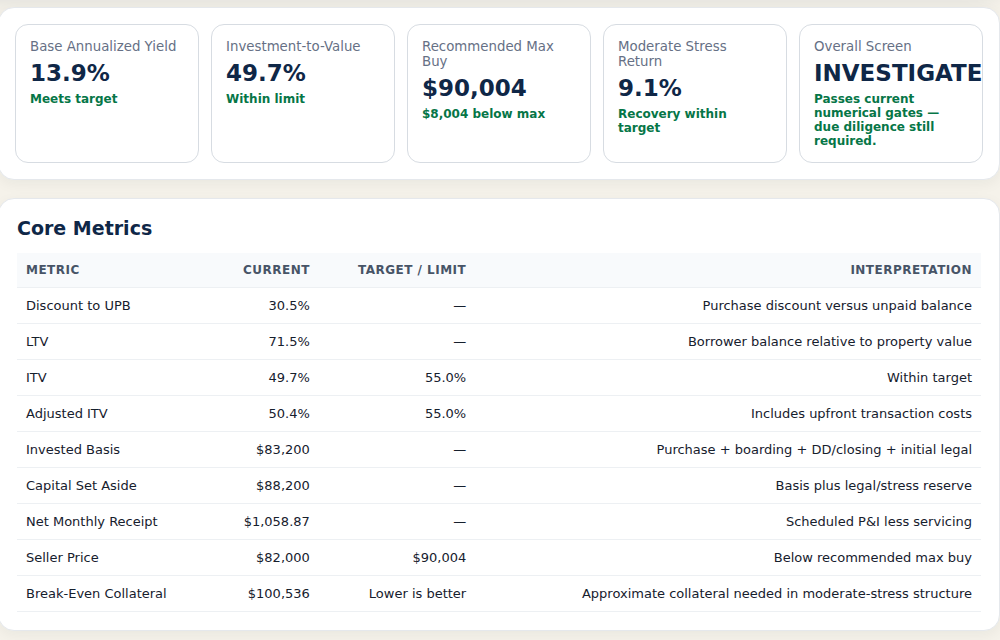
Use the same fictional note from our NotePro walkthrough: an $82,000 purchase price, $1,200 in initial costs, a $1,093.87 monthly principal-and-interest payment and a $35 monthly servicing assumption. The resulting invested basis is $83,200.
Twelve payments arrive
$12,706Scheduled receipts after servicingAbout 15.3% of the invested basis is received during the year. That still does not separate principal return from interest income.
Six payments, then a workout
$1,853Six net receipts minus $4,500 expenseThe simple first-year cash result falls to about 2.2% before considering later recovery or loss.
Early payoff after six months
Timing mattersReceipts plus verified payoff amountThe realized return depends on the payoff balance, exact date, accrued interest, fees and original price.
These are illustrations, not forecasts. The point is that one advertised yield can lead to very different outcomes.
Why early payoff deserves its own analysis
When a borrower pays early, the investor receives the payoff amount sooner and stops receiving future monthly payments. If the note was purchased at a discount, that may produce a strong annualized return. But the size of the discount, remaining balance and payoff date determine the result.
The current balance is not always the exact payoff amount. Accrued interest, fees and any valid prepayment provisions may affect the final figure. The loan documents and servicer’s payoff statement must be reviewed.
Yield does not measure risk
Two notes can show the same cash yield and have very different risk. One may have a long verified payment history, strong collateral and clean documents. The other may have weak records, a junior lien, unpaid taxes or a questionable valuation.
That is why a useful screen also looks at:
- Investment-to-value and combined lien exposure
- Verified payment history and current loan status
- Property value, condition, taxes and insurance
- Document chain, assignments and endorsements
- Servicing records and escrow information
- Legal timeline, expense reserve and downside scenarios
A better way to review the return
Cash yield should be one line on the dashboard—not the entire dashboard. A stronger review separates the following questions:
- Scheduled cash flow: What should arrive if the borrower pays as agreed?
- Net cash flow: What remains after recurring and transaction costs?
- Principal recovery: How much of the cash received reduces the asset balance?
- Timing: When is each receipt or expense expected?
- Scenario return: What happens under early payoff, interruption and stress?
- Collateral protection: What supports recovery if payments fail?
- Maximum price: What price fits your required return and risk assumptions?
How NotePro handles the bigger picture
NotePro keeps the quick yield visible, then adds the costs, investment-to-value, target-price framework, early-payoff view, stress scenarios, risk scorecard and due-diligence checklist. It does not predict the future or verify seller data. It helps keep the assumptions and the output in the same place.
Run the quick screen—then question the result.
Use the free analyzer for a first look. For cost modeling, scenario testing, saved deals and a complete due-diligence workflow, see the Note Investor Blueprint.
Educational content only. Mortgage-note investing involves risk, including possible loss of principal.